Korean Four Pillars 四柱八字 · 사주팔자
The birth chart Koreans check before they marry, move, or sign anything.
No planets, no sun sign. Saju reads the year, month, day and hour you were born as eight characters — and one of them is you. Enter your birthday and meet your Day Master.
- Free in 30 seconds
- Corrected to true solar time
- No account needed
Your Day Master · 일간
Yang Fire — The Sun
Not shown on this page · sent to your inbox
There's more in your eight characters.
Free. One email with your reading, one follow-up two days later. No spam, unsubscribe anytime.
Element balance · 오행
In practice
Want the whole chart?
The free email covers the parts above. The paid readings are written from all eight of your characters, with your next twelve months month by month.
What is Saju? 四柱
Saju means "four pillars." For over a thousand years Koreans have read the moment of birth not as a sky full of planets but as a calendar: the year, month, day and hour, each written as a pair of characters. Eight characters in total — the palja (八字) — every one of them an element: Wood, Fire, Earth, Metal or Water.
How the chart works
The most important character is the stem of your day pillar, the Day Master (일간). Western astrology has the Sun sign; Saju has this. Everything else in the chart is read in relation to it — which elements feed it, which ones drain it, which ones it controls.
In Korea this isn't fringe. It's what your mother checks before your wedding, what a founder checks before a launch date, and what has lines out the door at saju cafés in Seoul every New Year.
Who's reading your chart
I'm Mina. I grew up in Incheon, Korea, where a chart gets pulled before a wedding, before a move, and before at least one job offer. I started reading for friends, then for strangers, then for people who found me online. Daymaster is where I do it in English.
I read the way it's done in Korea: your birth hour corrected to true solar time, all eight characters together instead of one sign, and the ten-year cycles that say where you are right now. Every paid reading is written for one chart and never reused.
If something in your reading is off, reply to the email. It comes to me, not a help desk.
Yang Metal, three Earth, no Fire. My own reading says I over-prepare and carry problems that aren't mine. It isn't wrong.
Go deeper than the Day Master.
The free result above is the first line of your chart. A full reading is written for you, from your exact eight characters, and delivered as a PDF to your inbox.
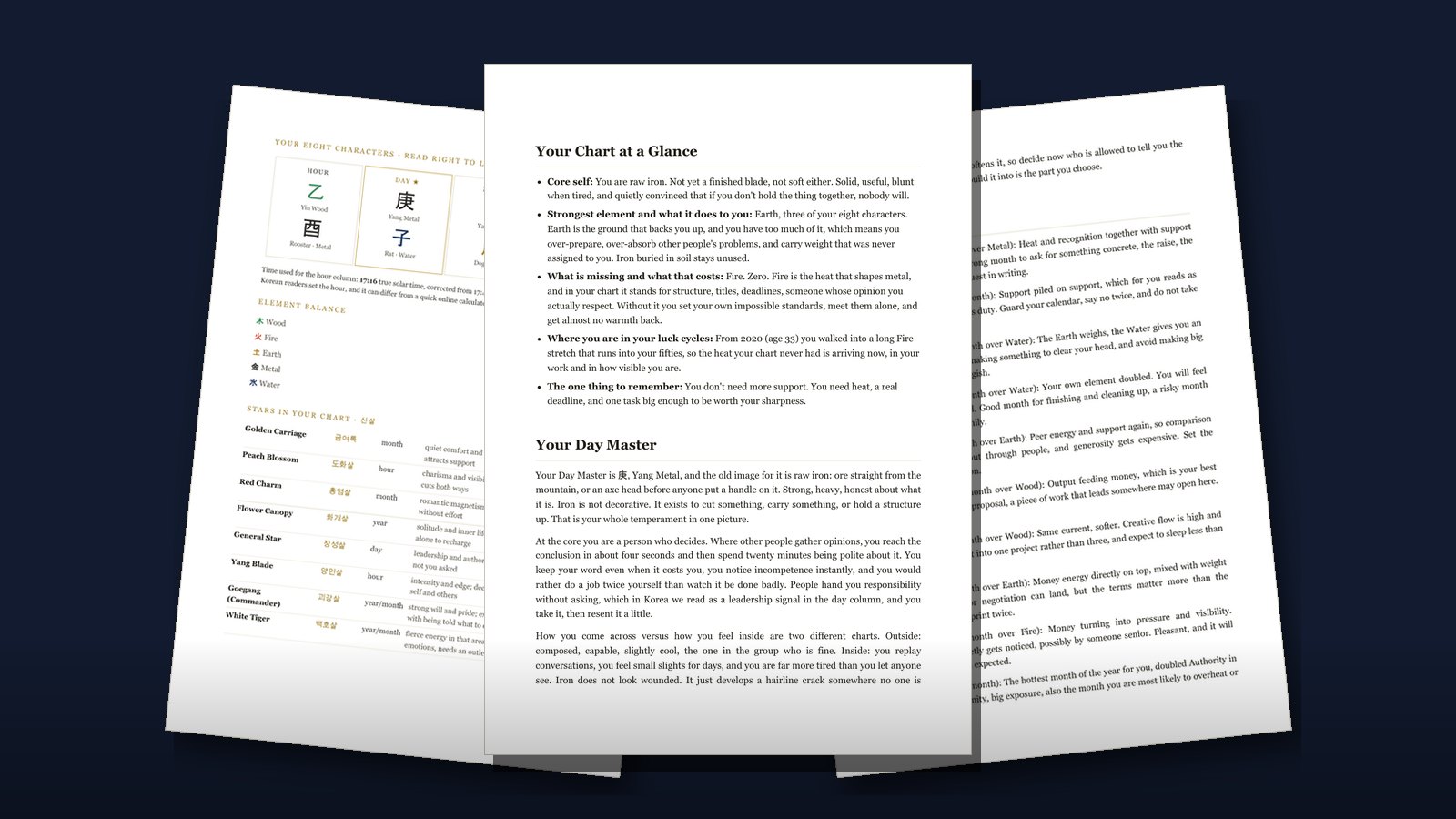
Your clock time is not your birth time.
A Korean reader never uses the hour on your birth certificate as is. It gets corrected to true solar time: daylight saving removed, then adjusted for how far east or west your birthplace sits in its time zone. Every paid reading does this from the city you give us.
Same person, a different hour pillar: a quarter of the chart. The PDF shows the time it used and how it got there.
What a reading picks up on
- Why you look decisive but second-guess everything in private
- The difference between handling pressure and losing control over how you work
- Why mixed signals feel like a puzzle you're supposed to solve
- What you need from a relationship, in words you can actually use
Examples of what charts often show. Yours is read from your own eight characters.
Free Day Master readings on X, one birthday at a time. Shared without the handle.
Day Master Snapshot
- Your Day Master and archetype
- All four pillars, colored by element
- Element balance
- Emailed to you as a keepsake
- Same for everyone with your Day Master. The readings below are written from your exact eight characters.
Career & Money Snapshot
- What kind of work your chart is built for
- Your money element — how it comes and how it leaves
- The one habit your chart says to stop
- 8-page PDF with a beginner's primer, written for your exact chart
- Your $9 comes off the Full Reading if you upgrade within 7 days
Full Saju Reading
- Everything in the Snapshot
- Relationships: who fuels you, who drains you
- Your 10-year luck cycles (대운) — where you are now
- The next 12 months, month by month
- 14+ page PDF, read from your exact chart the Korean way
Love & Reunion Reading
- Your chart and theirs, read side by side the Korean way (gunghap)
- An ex, your partner, or someone you can't read yet: you only need their birth date
- The pull, the friction, and the pattern you two keep repeating
- The reunion question answered honestly: what pulls you back, what broke it, what would have to change
- The months in the next year when closeness comes easier, and when to expect friction
- No promises and no tricks. A chart shows pull and timing; the other person still gets a say.
Questions
Is this the same as Chinese BaZi?
Same root, same eight characters. Saju is the Korean tradition that grew from it — the way it's read, the emphasis on the Day Master and on luck cycles, and its place in everyday life are distinctly Korean.
I don't know my birth time. Does it still work?
Yes. You'll get three of the four pillars — year, month and day — and your Day Master comes from the day, so it's unaffected. The hour pillar adds detail about later life and children; without it we simply leave that column blank rather than guess.
Why is my year animal different from the Chinese zodiac?
Saju switches years at Ipchun (입춘), the start of spring around February 4 — not at Lunar New Year. If you were born between Lunar New Year and February 4, your Saju animal is the previous year's.
Born in the US in summer? Your hour column might shift.
The free result above uses the clock time you typed. Paid readings do what a Korean reader does: remove daylight saving time and adjust for your birthplace's longitude to get true solar time. For many US summer births that moves the hour by 1–2 hours, which can change the hour column. Your Day Master (the day column) almost never changes.
Who writes the paid readings?
Mina, a Korean reader, from your exact chart, in plain English. Every reading is written for one person and never reused. Readings are for reflection and entertainment — they're not medical, legal or financial advice.